Cephalopod
Horned octopus
Eledone Cirrhosa
Out of season
—
Fishing zones
Wild
Origin
14,5 cm
Minimum size
Description
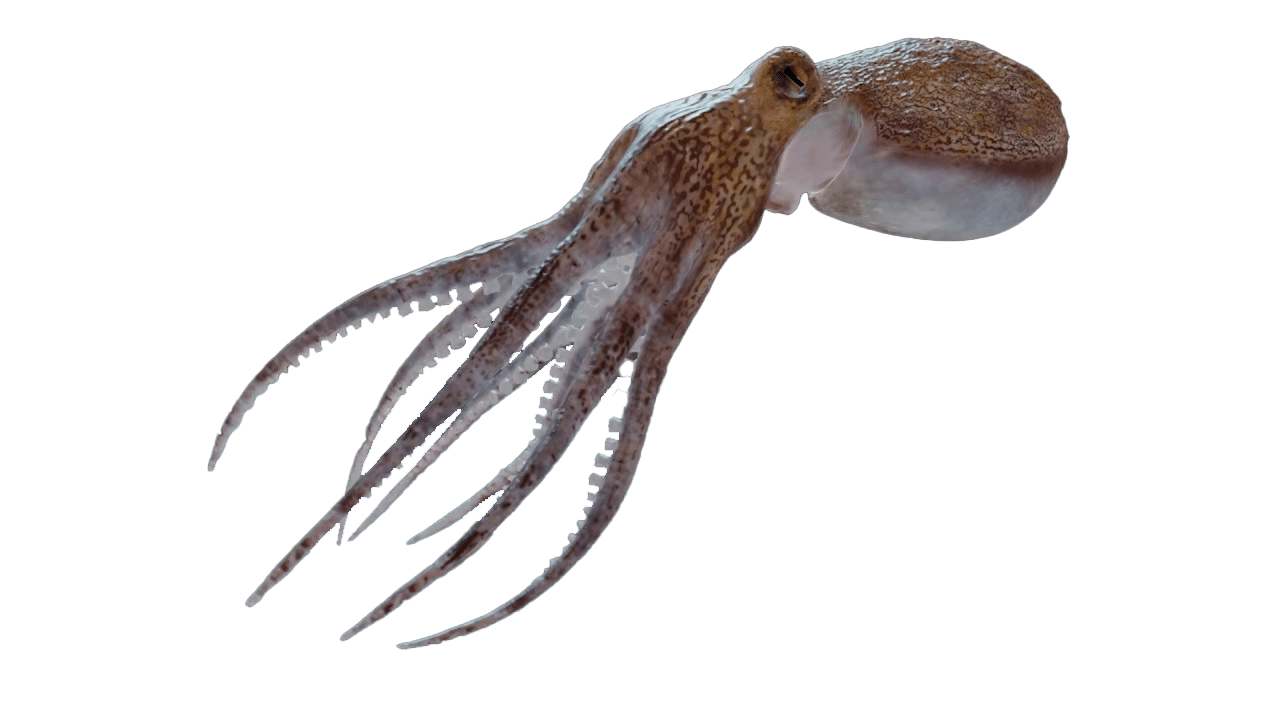
Its main distinguishing feature, which sets it apart from the common sea urchin (Sextus vulgaris), is that it has only a single row of suckers on each arm (instead of two). The body (mantle) is ovoid in shape, covered with small skin granules. The head is broad with protruding eyes. A small spike or "cirrus" is often visible above each eye (hence the name Horned octopus). It is generally yellowish, reddish, or orange-brown on the back, with a lighter (whitish) underside. The mantle typically measures between 10 and 15 cm, with a total length (including arms) that can reach 40 cm. It feeds mainly on crustaceans (crabs, lobsters) and mollusks, which it paralyzes with its toxic saliva before consuming them.
Habitat
A benthic species found on the continental shelf and the upper slope. It inhabits a fairly wide depth range, from 10 meters to about 800 meters, but is most abundant between 60 and 150 meters. Unlike the common octopus, which prefers rocky areas, the common eledone is found primarily on soft substrates (sand, mud, gravel), although it may also inhabit rocky areas.
Distribution
Its range is mainly limited to the northeastern Atlantic, from the coasts of Norway and Iceland to Morocco. It is very common in the North Sea and around the British Isles. It is found throughout the Mediterranean Sea, although at deeper depths it is sometimes replaced by its cousin, the musk flounder (Eledone moschata).