Fish
Poisson
Leerfish
Lichia amia
(GSA7) Gulf of Lion, (GSA8) Corsica
Fishing zones
Wild
Origin
60 cm
Minimum size
Description
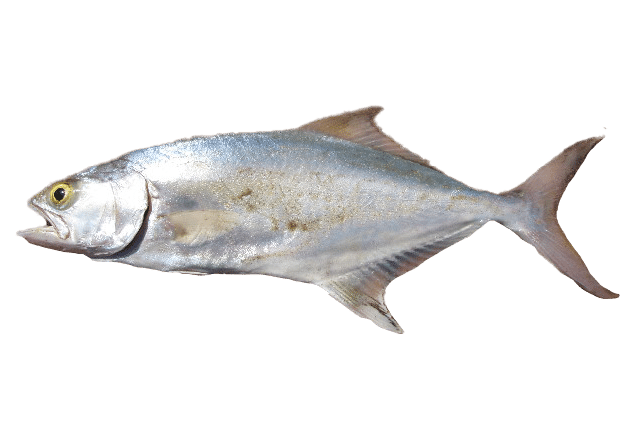
It is a fish with a spindle-shaped body, laterally compressed and highly hydrodynamic. Its head is pointed, with a large mouth whose slit extends to just below the back of the eyes. This is its most reliable distinguishing feature: the lateral line is not straight; it has a very sinuous (S-shaped) curve above the pectoral fin, before becoming straight toward the tail. The lobes of the dorsal and anal fins are elongated and pointed. The caudal fin (tail) is widely forked and very powerful. The back is greenish-gray to gray-brown, the sides are silvery, and the belly is white. The fins are often tinged with dark coloration. It can reach an impressive length of 1.50 m to 2 m, with a maximum recorded weight of about 50 kg. The average length is 1 m.
Habitat
It is a coastal pelagic fish. Unlike many large jackfish that live offshore, the liche often stays very close to the coast. It prefers rough waters, surf zones, estuary mouths, and sometimes even brackish lagoons (euryhaline). It is a formidable and swift predator that often hunts in small groups near the surface. It feeds mainly on other fish (mullet, sardines, garfish) and cephalopods. It is generally found between the surface and a depth of 50 meters.
Distribution
It is found throughout the Mediterranean basin, including the Adriatic Sea. It is particularly abundant along the coasts of North Africa and in the western Mediterranean during the summer. It ranges from the Bay of Biscay (where it is an occasional visitor) to South Africa, rounding the Cape of Good Hope and extending slightly northward toward Mozambique in the Indian Ocean.