Crustacean
Glacial lobster
Nephrops norvegicus
Out of season
—
Fishing zones
Wild
Origin
11 cm
Minimum size
Description
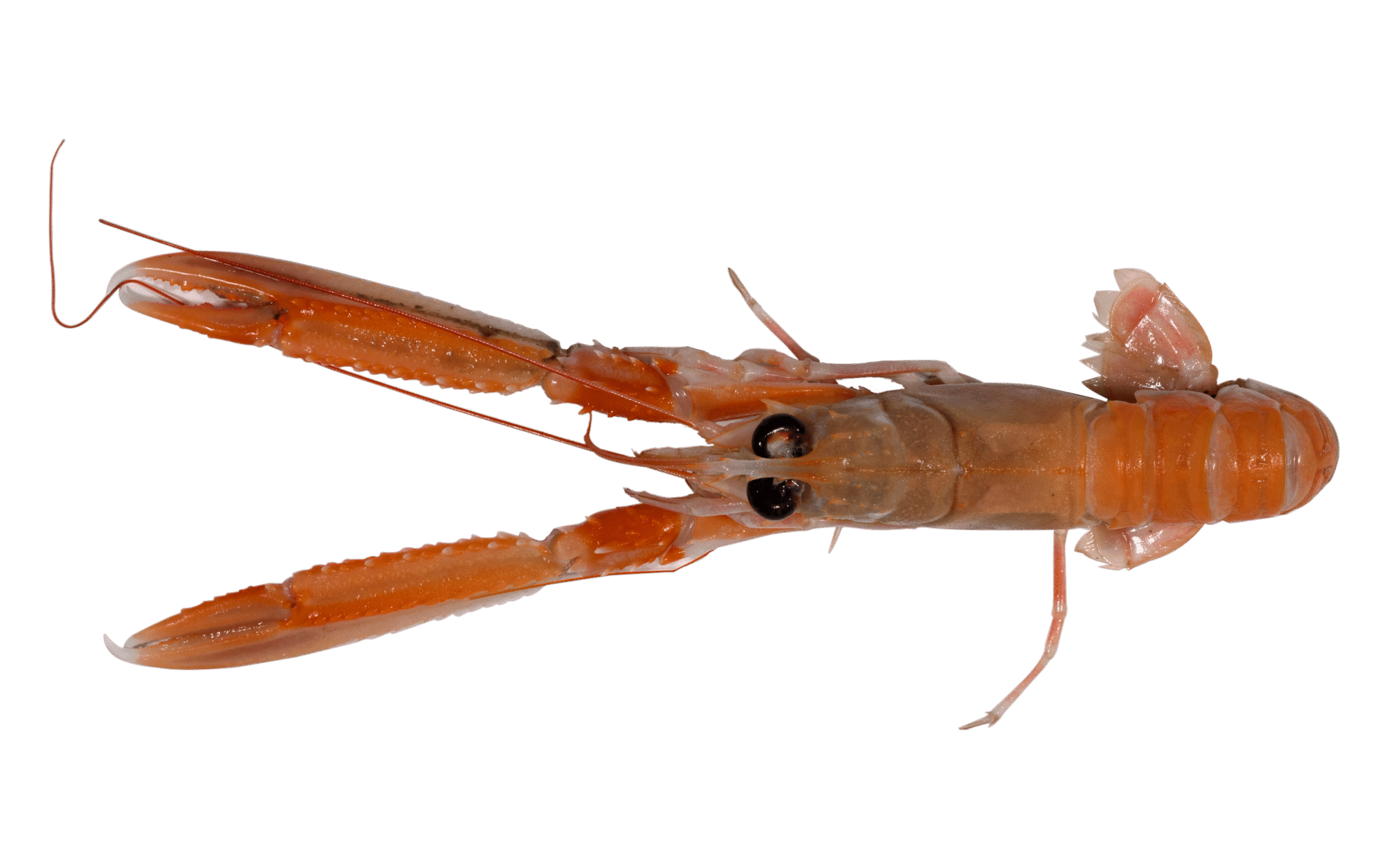
Unlike the common Norway lobster (Nephrops norvegicus), the ice lobster is blind (its eyes lack pigment and a functional cornea, which is typical of deep-sea species). It has a robust body with a well-developed rostrum. Its carapace is covered with fine granules and bristles (small hairs) that give it a slightly velvety appearance. Its first pairs of legs end in long, fairly slender claws, though less slender than those of the Norway lobster found in our markets. Its color ranges from pinkish-white to a fairly vivid orange-red. It is a modestly sized species, generally reaching a total length of 8 to 10 cm.
Habitat
It is a deep-sea benthic species (bathyal zone). It lives on soft substrates, mainly fine silt or sandy silt, in which it can dig burrows. It is found at significant depths, generally between 400 and 1,800 meters, although its optimal concentration zone is around 600 to 1,000 meters. It lives in cold, stable waters, hence its name 'icefish'.
Distribution
It is found from the Faroe Islands and western Scotland to the Gulf of Guinea and South Africa.