Fish
Mediterranean rainbow wrasse
Coris julis
Out of season
—
Fishing zones
Wild
Origin
11 cm
Minimum size
Description
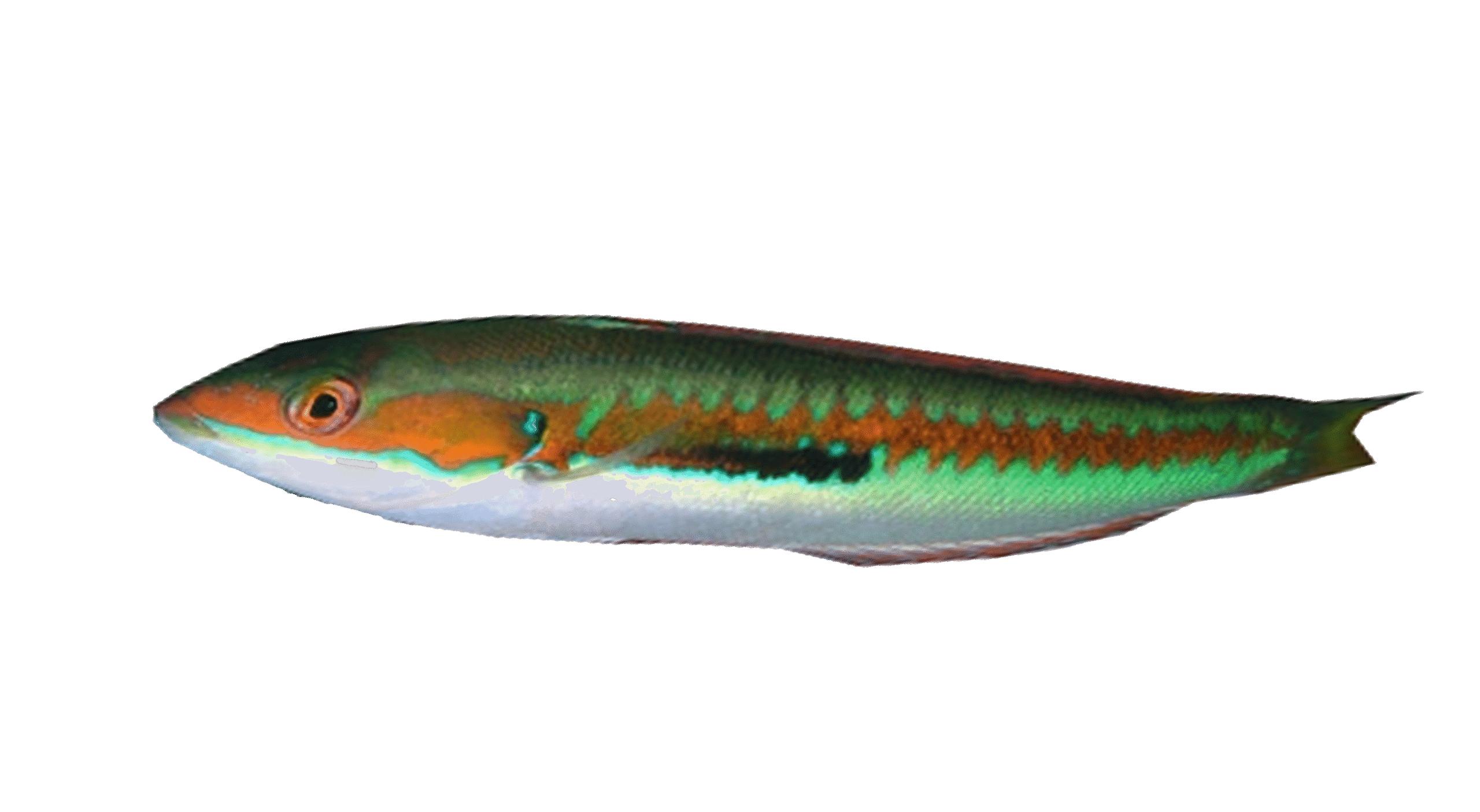
Its body is elongated, spindle-shaped, and laterally compressed. Its snout is pointed, ending in a small mouth with protruding teeth. This species exhibits two very distinct color patterns depending on its life stage. In the juvenile stage (females and young males), the back is orange-brown or greenish, separated from the white flanks by a white longitudinal band. In the adult stage (dominant male), it displays spectacular coloration. The back is blue-green, with a very distinct zigzagging orange band on the flank. It also has a characteristic black spot behind the pectoral fin, and the first rays of the dorsal fin are longer and colored black or orange. Its average size is 15 cm, but it can reach a maximum of 25 cm.
Habitat
It prefers rocky bottoms, scree, and Posidonia seagrass beds. It is often found in the immediate vicinity of the shore. It is a coastal fish that is very active during the day. The wrasse is known for burrowing into the sand to sleep at night or when it feels threatened. It is a curious fish that readily approaches divers, especially if the sediment is disturbed. It is mainly found between the surface and a depth of 60 meters, although it can descend to 120 meters.
Distribution
It is found from the coast of Gabon and the Canary Islands in the south to the Bay of Biscay in the north. It is sometimes reported as far south as the British Isles during periods of warmer water. It is present throughout the Mediterranean, in the Adriatic Sea, and in the southern part of the Black Sea.