Cephalopod
Horned octopus
Eledone cirrhosa
(GSA7) Gulf of Lion, (GSA8) Corsica
Zones de pêche
Wild
Origine
9,5 cm
Taille minimale
Description
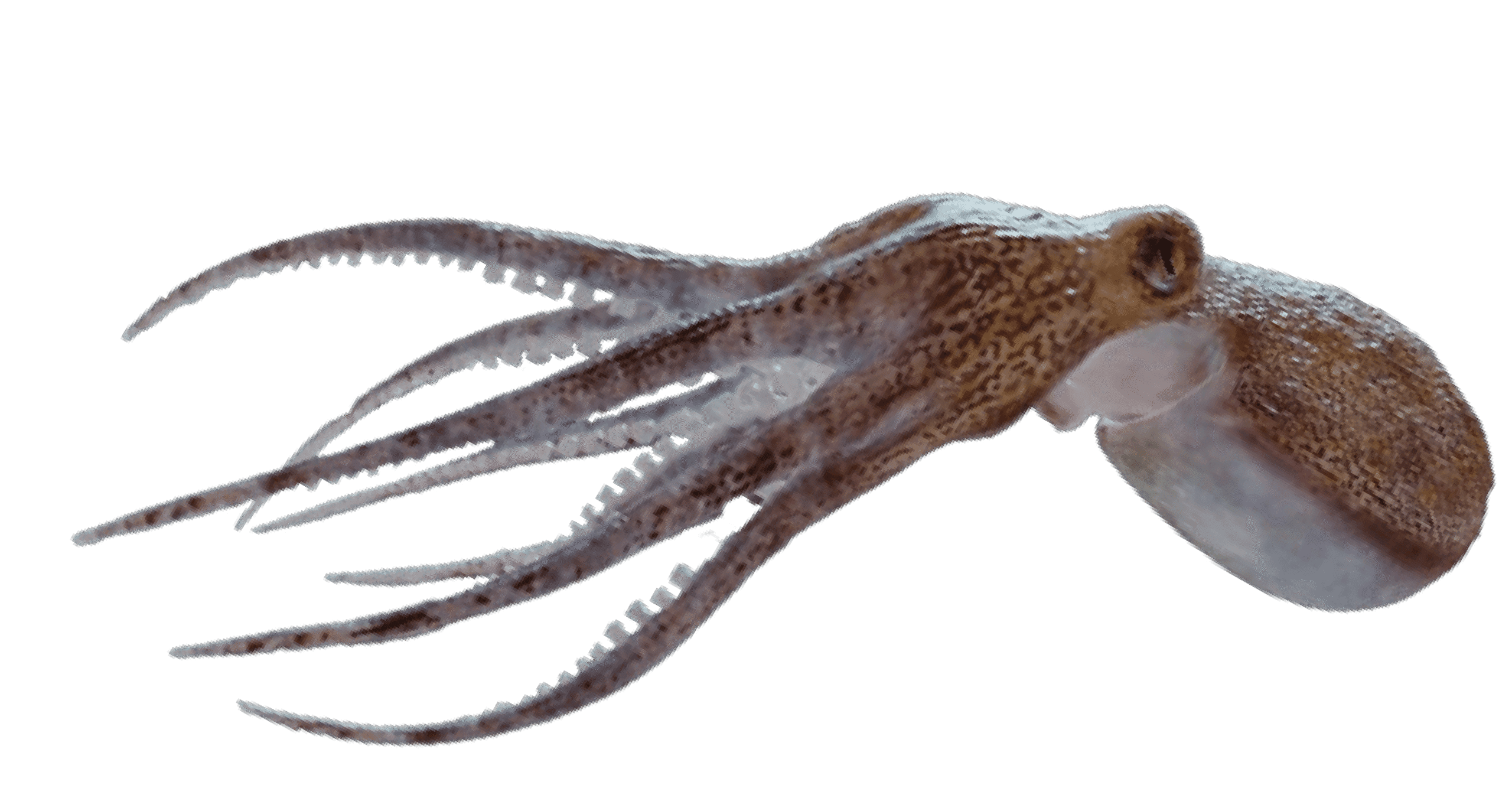
Unlike the common octopus, which has two rows of suction cups on each arm, the horned octopus has only one row. Its head is broad and features a small, fleshy protrusion above each eye, which gives it its English name, the horned octopus. Its skin is covered with fine granules (small warts) that give it a rough appearance. It is generally yellowish, orange, or reddish on the back, with a lighter, almost white belly. Like all cephalopods, it can change color to camouflage itself. Its mantle measures about 10 to 15 cm, with a total length (including arms) that can reach 40 cm.
Habitat
It thrives in a variety of seabeds: rocky, sandy, or muddy. It is less strictly tied to rocks than the common octopus. It is found at a wide range of depths, from 10 meters to 800 meters, although it is most common between 50 and 300 meters. It is a nocturnal predator that feeds mainly on crustaceans (crabs, lobsters) and mollusks. It is known to be a voracious consumer of shrimp.
Distribution
It is found in the northeastern Atlantic and the Mediterranean. Its range extends from northern Norway and Iceland to the coast of Morocco. It is very common in the North Sea, the English Channel, and the Bay of Biscay. It is also well represented throughout the Mediterranean basin, although it is sometimes less abundant there than its cousin, the musk duck (Eledone moschata).