Fish
Poisson
European conger
Conger conger
(GSA7) Gulf of Lion, (GSA8) Corsica
Fishing zones
Wild
Origin
75 cm
Minimum size
Description
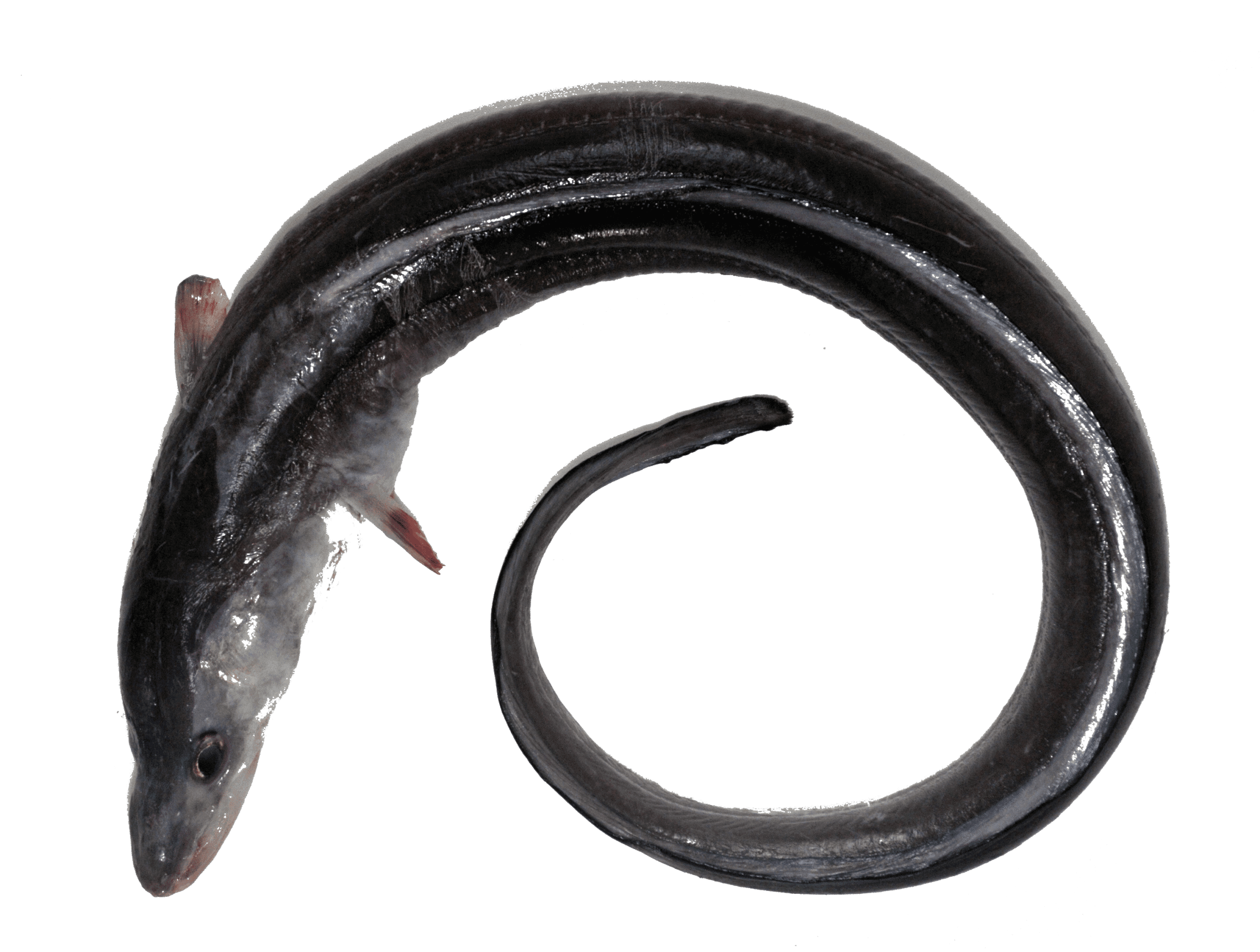
The body is very elongated, cylindrical in the anterior portion and laterally compressed toward the tail. It has no scales. Its head is massive, with a rounded snout and an upper jaw that is slightly longer than the lower jaw. Its mouth is wide, slit-like up to the middle of the eye, and lined with small but very sharp, closely set teeth. The dorsal, caudal, and anal fins are fused into a single ridge running along the body. Its color varies depending on habitat and age, ranging from light gray to bluish black on the back, with a white or silvery belly. The fins are often edged with black. It is a giant: while the average size is 1 to 1.5 meters, females (which are larger than males) can reach 3 meters in length and weigh over 60 kg.
Habitat
It is a bottom-dwelling (demersal) fish that prefers rocky substrates offering plenty of hiding places (fissures, caves, shipwrecks). It is found from the coast (intertidal zone) down to great depths, around 1,000 meters. Primarily nocturnal, it spends the day hidden in its burrow, often leaving only its head exposed. It is a formidable predator of fish, crustaceans, and cephalopods.
Distribution
It is widely distributed throughout the eastern Atlantic. It is found from Norway and Iceland in the north to Senegal in the south. It is extremely common throughout the Mediterranean Sea as well as in the Black Sea. It is also found around the Azores, Madeira, and the Canary Islands.