As part of the Mr.Goodfish3.0 project, our Arctic Pilot Site in Tromsø, coordinated by Nordnorsk vitensenter, is putting co-creation into practice. After inviting people from Tromsø’s local seafood value chain, residents and consumers to contribute to the project through surveys and workshops, the local community pointed out the lack of cooking skills of the population as a challenge to promoting responsible seafood consumption in the region. As a result, on the 27th of November 2025, Nordnorsk vitensenter teamed up with students from UiT—the Arctic University of Norway to organise Try Me, a beginner-friendly cooking workshop designed to encourage young people to make more confident and responsible seafood choices.
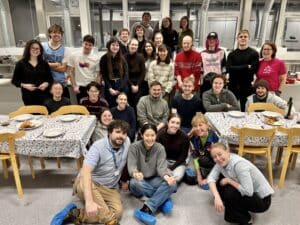
The motivated and engaged student organizers in the front row from left to right: Maria (Spain), Alessandro (Italy), Miyu (Japan), Candela (Spain), Astrid (Denmark), and Nora (Norway).
Co-creating local solutions withing Mr.Goodfish3.0
As one of the project’s Pilot Sites, Nordnorsk vitensenter has been actively engaging local actors to identify barriers to responsible seafood choices and develop locally relevant, action-oriented responses. Through surveys and workshops, participants at the Arctic Pilot Site highlighted several challenges faced by young people, including limited cooking skills, concerns about price and availability, and uncertainty around how to prepare seasonal fish. In response, the Pilot Site collaborated with students to co-design a practical initiative that could address these challenges in an accessible and engaging way.
The result was Try Me: an introductory cooking workshop focused on building confidence, skills, and curiosity around seafood.
Learning to cook seasonal seafood and more of the fish
Six students from UiT – The Arctic University of Norway, with backgrounds from Spain, Italy, Japan, Denmark, and Norway, took part in the initiative. Drawing on information from Råfisklaget, Smak av Kysten, and our Mr.Goodfish seasonal lists, they selected monkfish (also known as anglerfish) as their “seasonal star”. “The students developed the idea through a series of workshops here at [Nordnorsk Vitensenter]”, say Holly Hasted and Nina Boine Olsen, from the science centre, “their task was to design a local, action-oriented measure that could encourage young people to make more responsible seafood choices. And they really delivered.”
During the workshop, participants explored different ways of preparing monkfish, including lesser-used parts such as the liver and stomach. The group created recipes inspired by different culinary traditions: pan-fried monkfish fillet with a Scandinavian butter emulsion, oven-baked monkfish with olive oil and roasted bell pepper purée from Southern Europe, and the infamous liver-and-stomach dish with a Japanese dip.
By encouraging the use of more parts of the fish, the students also highlighted how cooking choices can help reduce food waste while remaining tasty and accessible.
A student-led, hands-on experience
In total, 24 participants and six student organisers, representing twelve nationalities, took part in this first edition of the cooking workshop. Feedback from participants underlined the value of a fast, practical and welcoming format, as well as the opportunity to discover a new species and learn about seafood seasonality.
The students involved met eight times over the course of two months to design the concept, test recipes, and develop communication materials. Their work illustrates how co-creation, a core element of Mr.Goodfish3.0, can empower young people to become active agents of change, translating stakeholder concerns into tangible actions that resonate locally.